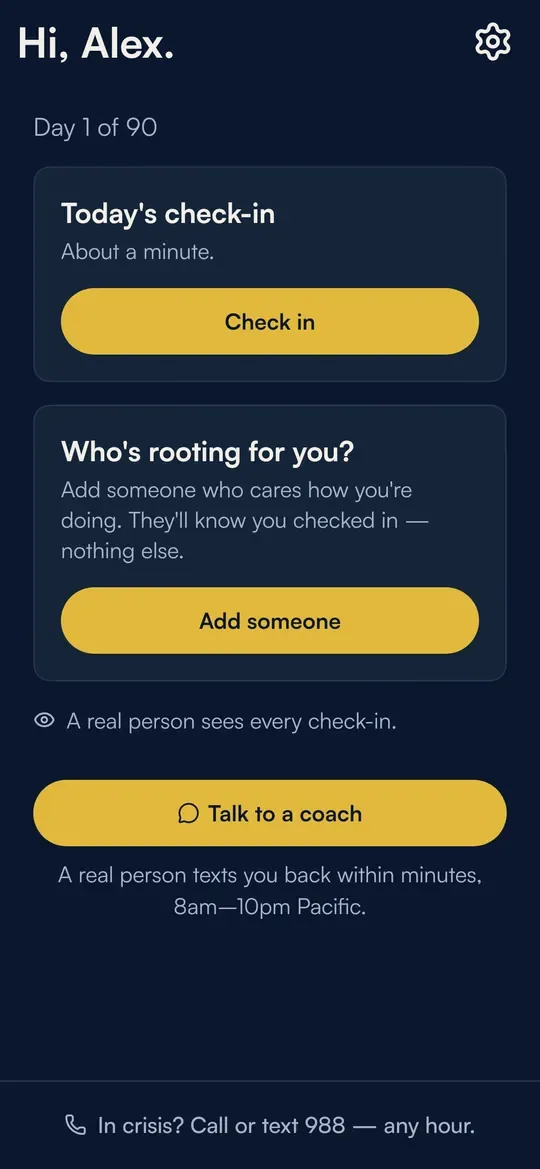
An app for the ninety days after you leave treatment. About a minute a day, and a real person at the other end of it.
You join with a short code from whoever referred you — a treatment center, an attorney, a psychologist, a psychiatrist or a therapist. The app costs nothing, and there is nothing to pay for inside it.
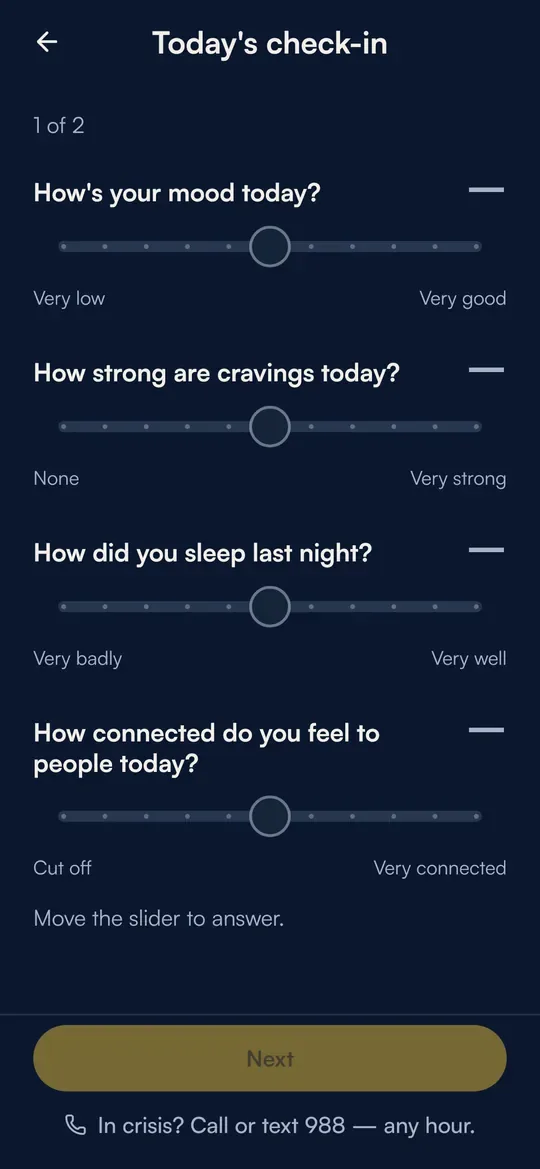
One minute a day
Four sliders — mood, craving, sleep, connection. Nothing to type. The same four questions every day, so a change is visible over weeks.
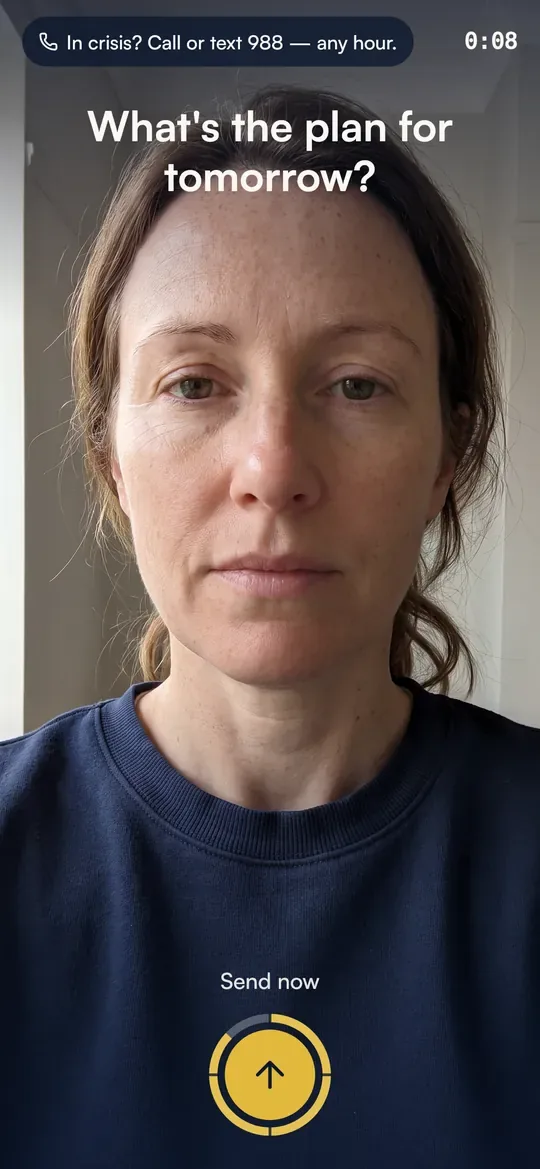
Then sixty seconds on camera, if you want it. Voice only works. So does nothing at all — a day you cannot film still counts as a check-in.
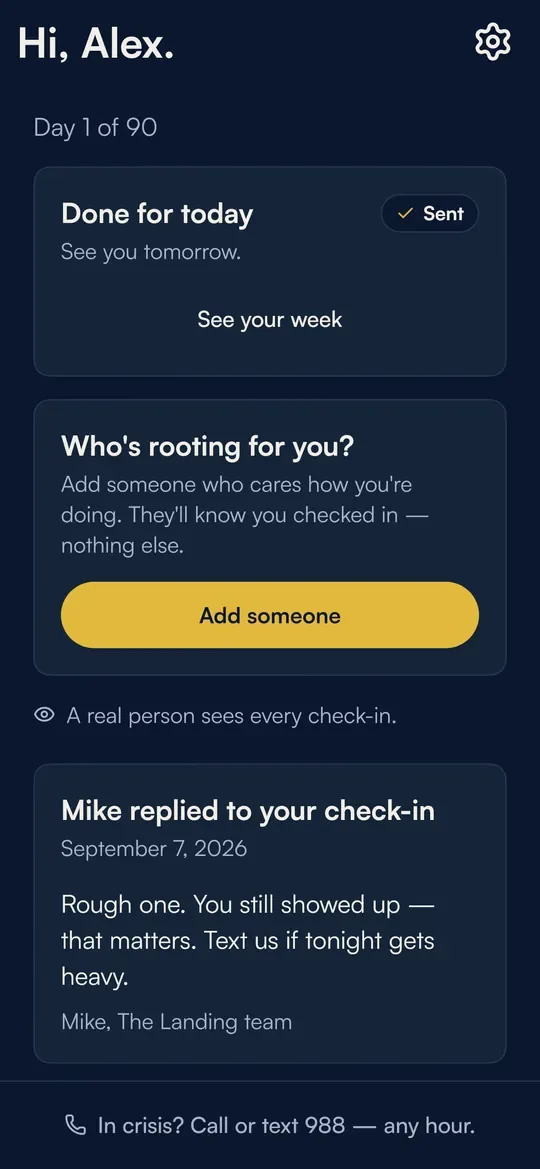
A real person at Global Recovery & Wellness sees every check-in. Often they write back, in their own words, with their first name and the date. Writing back to them inside the app is being built now.
Two things and a way to ask for help.
Four sliders. Nothing to type.
Then sixty seconds, if you want it.
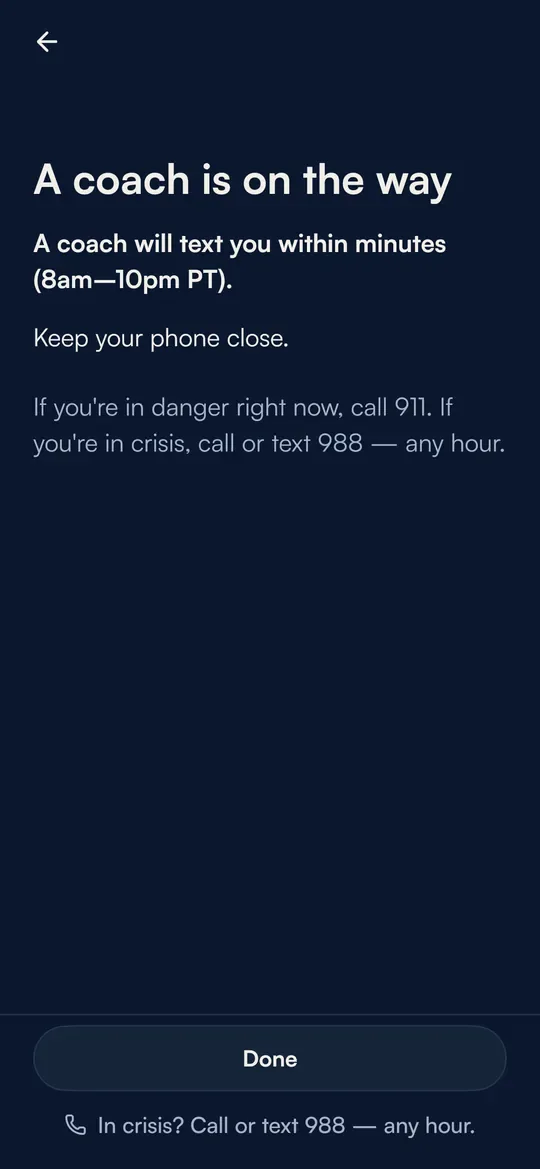
If you need a person, press the button
Talk to a coach. One tap, no form, no reason to give. A coach will text you back within minutes, between 8am and 10pm Pacific.
If it does not go through, the app says so. It will never tell you a coach is coming when nobody was told.
988 is on every screen in the app, at every hour.
The promise the app actually made.
A reply, written by the person who read it.
People rooting for you
You can invite family, a friend or a sponsor to hear one thing a day: that you checked in.
Never your answers. Never your scores. Never your video.
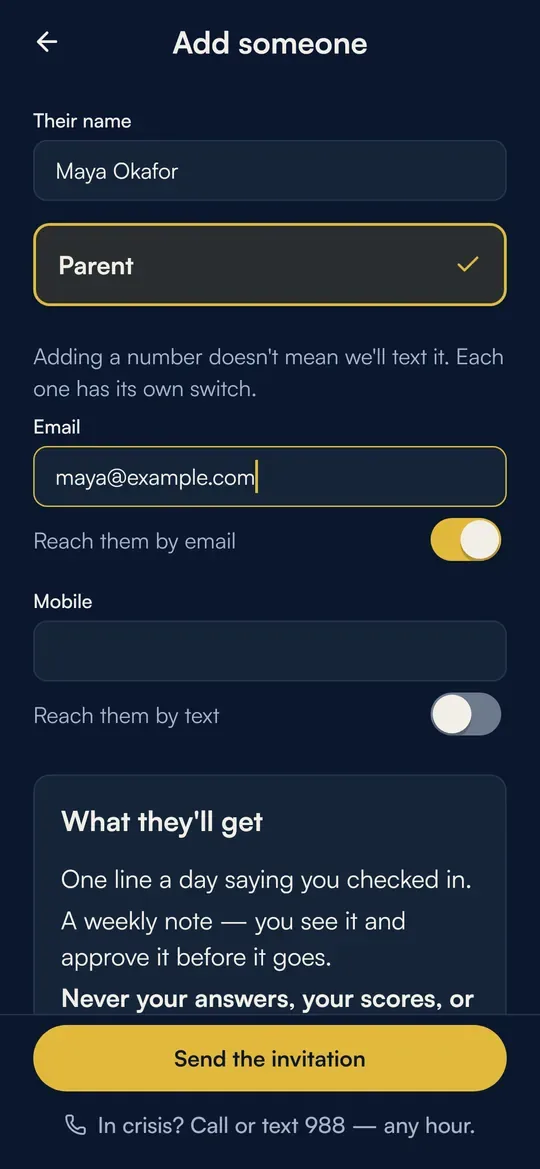
Everyone you add is invited first and has to accept. You see the exact sentence they will read before you send it.
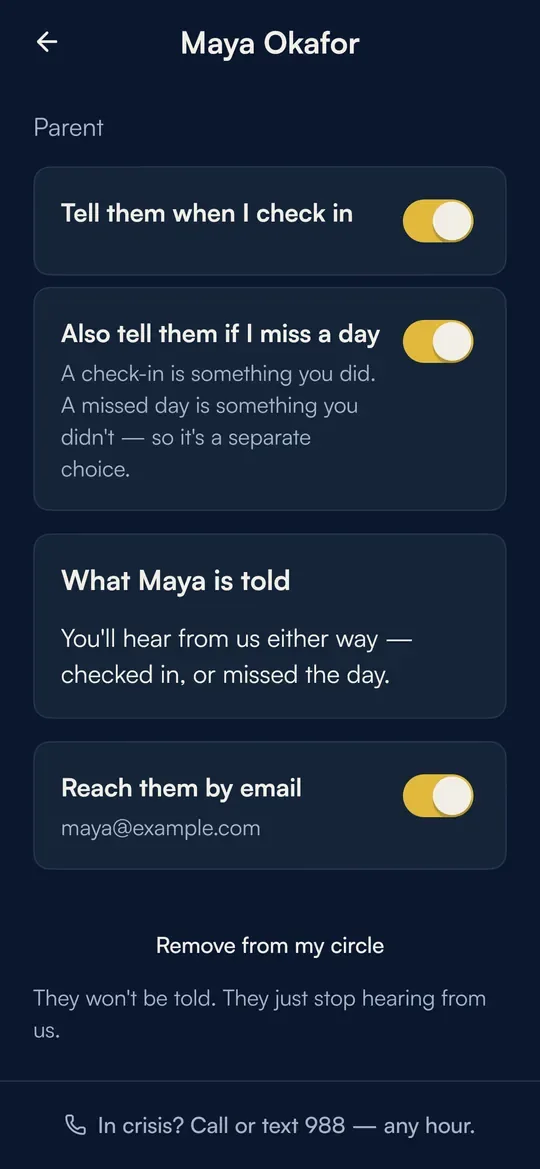
If you want someone told when you miss a day, there is a separate switch for that, and it is off unless you turn it on. A check-in is something you did; a missed day is something you did not.
Once a week there is a short note to your circle. You read it and approve it before it goes.
You can pause the whole circle, or take one person out. Removal happens right away, and nobody is told they were removed.
Adding a number is not agreeing to be texted on it.
Two switches, because they are two different things to tell someone.
Day 7, day 30, day 60, day 90
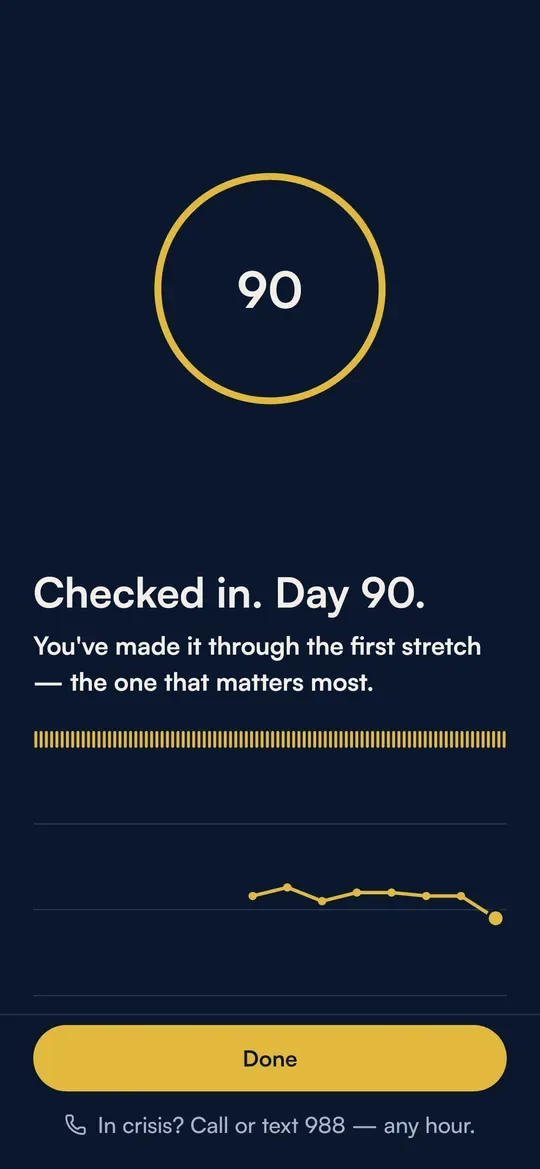
The milestones are the only place the app marks time back at you, and they are quiet lines rather than badges.
Day 90 is a graduation, written as a handover rather than a cancellation notice.
Day 90.
Whoever referred you sees what you decide
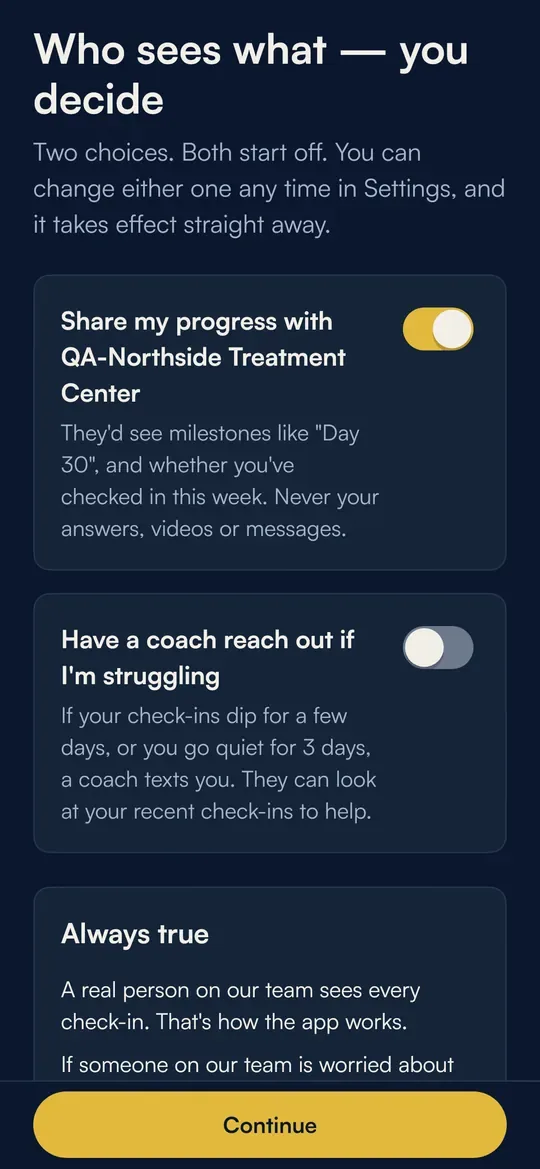
Sharing starts switched off. The app works exactly the same if you leave it off.
Turn it on and whoever referred you sees your first name, the milestones you reach — joined, day 7, day 30, day 60, day 90, graduated — and whether you have checked in this week or gone quiet.
They never see your answers to any question, your scores, your videos or voice notes, or anything you say to a coach.
You read that list before you agree to it, and you can change your mind in Settings at any time. It takes effect right away.
Both start off. Neither is needed to use the app.
It stays your account
You can delete it from inside the app. There is no email to support and no one to ask.
Deleting hides you from everyone right away and starts a 45-day clock. Sign in again before it ends and all of it comes back — people in early recovery delete things on bad nights, and a way back is a kindness.
After 45 days your check-ins, your videos and your messages are erased. The app names that date on the way out.
Coming to iPhone and Android
The Landing is not in the app stores yet.
You will get a code from whoever referred you. That code is the whole sign-up — there is no form and no password, and your phone number is the only other thing you need.
If you refer people — a treatment center, a law practice, a clinic — start at The Landing Partnership.
Coming soon toiPhoneComing soon toAndroid
In an emergency
The Landing is not medical care, not treatment, not therapy, and it is not a crisis service. If someone is in danger right now, call 911. If you are in crisis, call or text 988 — any hour.